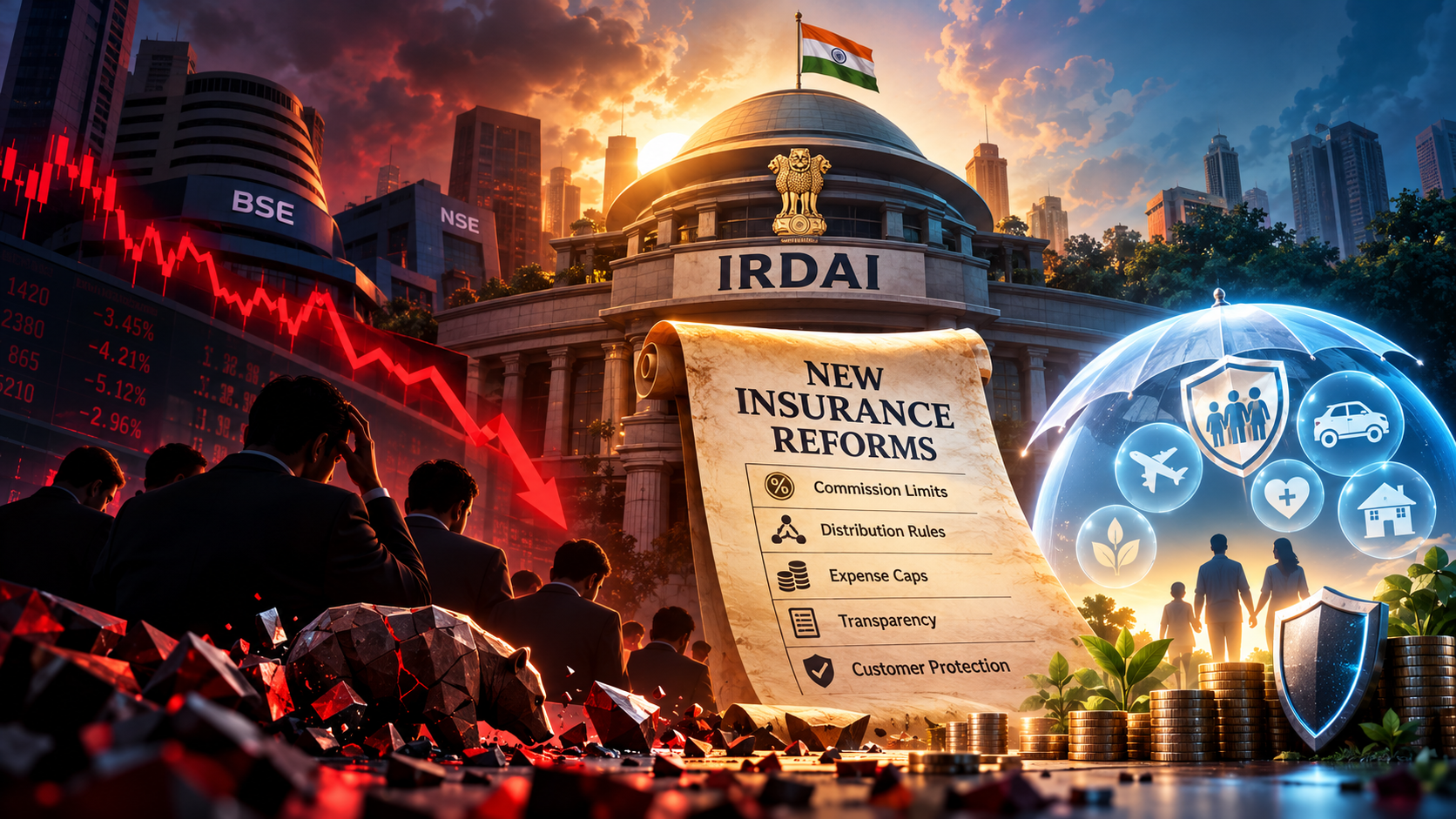
Primary Keyword: Insurance stocks fall 2026
Secondary Keywords: why insurance stocks are falling, IRDAI insurance reforms 2026, Indian stock market fall, insurance commission changes, PB Fintech share price fall, insurance sector India 2026
Introduction
Indian insurance stocks came under heavy selling pressure in September 2026 after the Insurance Regulatory and Development Authority of India (IRDAI) proposed significant changes to the way insurance products are distributed and how commissions and expenses are managed.
The announcement triggered a sharp reaction in the stock market, particularly among insurance distributors and companies whose earnings are closely connected to insurance distribution income. PB Fintech, the parent company of Policybazaar, was among the most heavily affected stocks, falling about 36% on September 24. Other insurance-related companies and some banks also came under pressure.
But why did the market react so strongly?
The answer lies in one important issue: how much money insurance companies and distributors may earn from selling policies under the proposed framework.
What Caused the Fall in Insurance Stocks?
The immediate trigger was an IRDAI consultation paper titled “Recalibrating Economics of Insurance Distribution.”
The proposed framework covers several areas, including:
- Insurance commissions
- Distribution expenses
- Sales practices
- Market conduct
- Transparency
- Digital distribution
- Customer protection
- Expense management
The regulator’s objective is to make insurance distribution more transparent and reduce practices that may encourage unsuitable policy sales.
For investors, however, the proposals raised a different concern: lower commissions and tighter expense limits could reduce the revenue or profitability of companies that depend heavily on insurance distribution.
This explains why the stock-market reaction was particularly severe for insurance distributors.
Why Did PB Fintech Fall So Sharply?
PB Fintech, the parent company of Policybazaar, experienced one of the biggest declines.
Its shares fell approximately 36% on September 24, 2026, according to Reuters and other reports covering the market reaction.
The reason investors were concerned is relatively straightforward.
Online insurance platforms generate revenue by helping customers compare and purchase insurance products. Their business economics therefore depend partly on the commissions and other payments associated with policy distribution.
If regulators reduce the amount that insurers can pay distributors, investors may expect the economics of acquiring customers to change.
That creates several questions:
- Will revenue per policy decline?
- Will customer acquisition become less profitable?
- Will companies need to spend more carefully on marketing?
- Could profitability growth slow?
- Could companies change their pricing or business models?
These uncertainties can cause investors to reassess the valuations of affected companies.
What Are the Proposed Commission Changes?
One of the most important parts of the proposed framework concerns commissions.
For life insurance, IRDAI has proposed limits under which first-year commissions could be capped at 20% of the premium for distributors and 25% for agents, according to reporting on the consultation paper. The proposal represents a significant change from the previous commission environment.
The regulator is also examining broader expense-management limits.
The proposed framework would move toward tighter limits on the expenses insurers can incur, including distribution-related costs.
According to reporting citing CareEdge Ratings, many insurers currently have expense ratios above the proposed levels for 2028-29.
This is why investors are examining the proposals closely.
Why Would Lower Commissions Affect Stock Prices?
Stock prices are influenced by expectations about future earnings.
Imagine an insurance distributor earns ₹100 from a policy today.
If regulatory changes eventually reduce the amount it receives to ₹70, the company cannot simply assume that its previous revenue growth will continue unchanged.
It may have to:
- Sell more policies
- Reduce marketing expenditure
- Improve conversion rates
- Increase customer retention
- Develop new revenue streams
- Reduce operating costs
Investors therefore try to estimate what the new economics could look like.
If expected future profits decline, investors may be willing to pay a lower valuation for the company.
That is one of the mechanisms through which regulatory uncertainty can translate into a stock-price decline.
Insurance Stocks Were Not All Affected Equally
The September market reaction was not uniform across the insurance industry.
Insurance distributors with substantial exposure to commission-based income faced particularly strong selling pressure.
PB Fintech experienced the sharpest decline among the widely reported names. Turtlemint also saw a significant fall, while listed insurers such as HDFC Life and ICICI Prudential Life experienced smaller declines during the period covered by reports.
This distinction matters.
An insurance company and an insurance distributor do not necessarily have the same business model.
An insurer collects premiums and manages insurance risk.
A distributor primarily helps sell insurance products.
Therefore, a regulatory change affecting distribution economics can affect these businesses differently.
What About Banks?
Banks could also be affected because insurance is an important cross-selling business for many financial institutions.
Banks have large customer bases and extensive branch networks, which allow them to distribute insurance products alongside banking services.
If insurance commissions decline, the income banks receive from insurance distribution could also come under pressure.
However, the impact may differ from bank to bank depending on their insurance relationships, subsidiaries, distribution model and overall revenue mix.
Analysts cited in reporting have noted that banks with their own insurance businesses may have some insulation because changes that reduce distribution payouts could potentially benefit insurers through lower costs.
Is This the Same as the Government’s 100% FDI Insurance Reform?
No.
This distinction is important.
India’s insurance sector underwent a major legislative change through the Sabka Bima Sabki Raksha (Amendment of Insurance Laws) Act, 2025.
One of the major changes was raising the foreign direct investment limit in Indian insurance companies from 74% to 100%.
The government said the measure was intended to attract investment, support technology transfer, increase insurance penetration and strengthen the sector.
The 100% FDI reform and the September 2026 IRDAI distribution proposals are therefore different developments.
The FDI reform potentially opens the sector to greater foreign ownership and capital.
The September consultation paper focuses substantially on the economics and conduct of insurance distribution.
Combining the two into one “government change” would be misleading.
Why Is IRDAI Proposing These Changes?
The regulator’s stated objectives include improving customer protection, reducing mis-selling and addressing practices that could influence customers toward unsuitable insurance products.
IRDAI has also highlighted concerns about commission-led distribution.
According to reporting on the consultation paper, general-insurance premiums generated through brokers increased 37% between 2022-23 and 2024-25, while commissions increased much faster, by 173%. In life insurance, premiums from corporate agents increased 28%, while commissions rose 125% over the same period.
The regulator is therefore attempting to change the incentives within the distribution system.
The central question is whether insurance products should be sold primarily because they generate attractive commissions or because they provide appropriate value to customers.
What Could the Changes Mean for Insurance Customers?
The proposals could have both potential benefits and challenges.
Potential benefits
If implemented effectively, tighter distribution rules could encourage:
- Greater transparency
- Better comparison of insurance products
- Less incentive for unsuitable selling
- Greater focus on product quality
- Improved customer protection
- More disciplined distribution expenses
Potential challenges
There could also be unintended consequences.
Lower commissions could make some low-value insurance policies less attractive to distributors.
This could matter particularly in smaller cities and lower-income segments, where distribution costs can be relatively high compared with premium amounts.
Industry representatives have raised concerns that the proposed structure should account for the different cost structures faced by insurers and distributors.
Could Insurance Stocks Recover?
It is too early to determine the long-term market impact.
The current proposals are not necessarily the final regulatory framework. IRDAI has invited stakeholders to submit comments, with the consultation period reported to run until October 25, 2026.
The final rules could differ from the consultation proposals.
Investors will therefore be watching several developments:
- Final commission rules
- Expense-management limits
- Implementation timelines
- Treatment of different distribution channels
- Impact on insurance aggregators
- Impact on banks
- Insurer profitability
- Customer acquisition costs
- Policy persistency
These factors will determine the eventual financial impact more clearly than the initial market reaction.
What Should Investors Watch Now?
Investors following Indian insurance stocks should avoid looking only at the headline percentage fall.
Instead, several fundamental indicators deserve attention.
1. New business growth
Is the company continuing to acquire customers and increase premium volumes?
2. Customer acquisition cost
How much does the company spend to acquire each new customer?
3. Commission income
How important are commissions to the company’s total revenue?
4. Profit margins
Can the company maintain profitability if distribution economics change?
5. Persistency
Are customers continuing to maintain their insurance policies?
6. Expense ratios
Can companies operate within the proposed regulatory expense framework?
7. Product mix
A business dependent on a particular category of insurance may experience a different impact from a diversified company.
The Bigger Picture for India’s Insurance Industry
The immediate stock-market decline tells only one part of the story.
India is simultaneously trying to expand insurance coverage, attract more capital and strengthen consumer protection.
The government’s insurance-law reforms have opened the sector to up to 100% foreign investment, while IRDAI’s regulatory initiatives are attempting to reshape how insurance products are distributed.
These developments create a changing environment for insurers, brokers, banks and digital insurance platforms.
For investors, the important question is therefore not simply:
“Why did insurance stocks fall?”
A better question is:
“How will the new regulatory economics change the future earnings model of each company?”
That answer will depend on the final regulations and how individual businesses adapt.
Conclusion
The September 2026 fall in Indian insurance-related stocks was largely driven by investor concerns surrounding IRDAI’s proposed reforms to insurance distribution, particularly potential limits on commissions and expenses.
PB Fintech and other distribution-focused businesses experienced particularly strong selling pressure because changes in commission economics could directly affect their revenue model. Banks with significant insurance-distribution income were also watched closely.
At the same time, it is important not to confuse these proposals with India’s separate insurance-sector FDI reforms, which increased the foreign-investment ceiling to 100%.
The final impact will depend on the rules eventually adopted, the implementation timeline and how insurers and distributors adapt their business models.
For investors, the next phase will be less about reacting to one day’s stock-market movement and more about understanding the long-term economics of insurance distribution in India.
Frequently Asked Questions
Why are insurance stocks falling in India in September 2026?
The immediate market trigger was IRDAI’s proposed reforms covering insurance distribution, commissions, expenses and sales practices. Investors were concerned that the changes could reduce earnings for companies dependent on insurance distribution income.
Why did PB Fintech shares fall sharply?
PB Fintech, which operates Policybazaar, is significantly exposed to insurance distribution economics. Its shares fell about 36% on September 24, 2026, after the regulatory proposal raised concerns about future commission income.
Did the Indian government reduce foreign investment in insurance?
No. India’s 2025 insurance-law reforms increased the foreign direct investment limit in Indian insurance companies from 74% to 100%.
Will insurance commissions be reduced permanently?
The September 2026 changes were proposed through an IRDAI consultation process. The final framework may differ from the proposals, so investors should distinguish between proposed rules and final regulations.
Are insurance stocks likely to recover?
The future direction depends on the final regulations, their implementation and their effect on company earnings. It is too early to determine the long-term market impact from the initial sell-off alone.
Disclaimer: This article is for informational and educational purposes only. It is not investment advice, a recommendation to buy or sell any security, or a prediction of future stock prices. Investors should conduct their own research and consider their financial circumstances before making investment decisions.
Author: Shree Krishna