Author: Shree Krishna
Published: September 28, 2026
Artificial intelligence is moving into a new phase in 2026.
For several years, most people experienced AI through chatbots that answered questions, generated text, created images or helped write code. The latest generation of AI systems is increasingly designed to go beyond answering prompts. They can use computers, interact with applications, work with documents, perform multi-step tasks and continue working toward a goal.
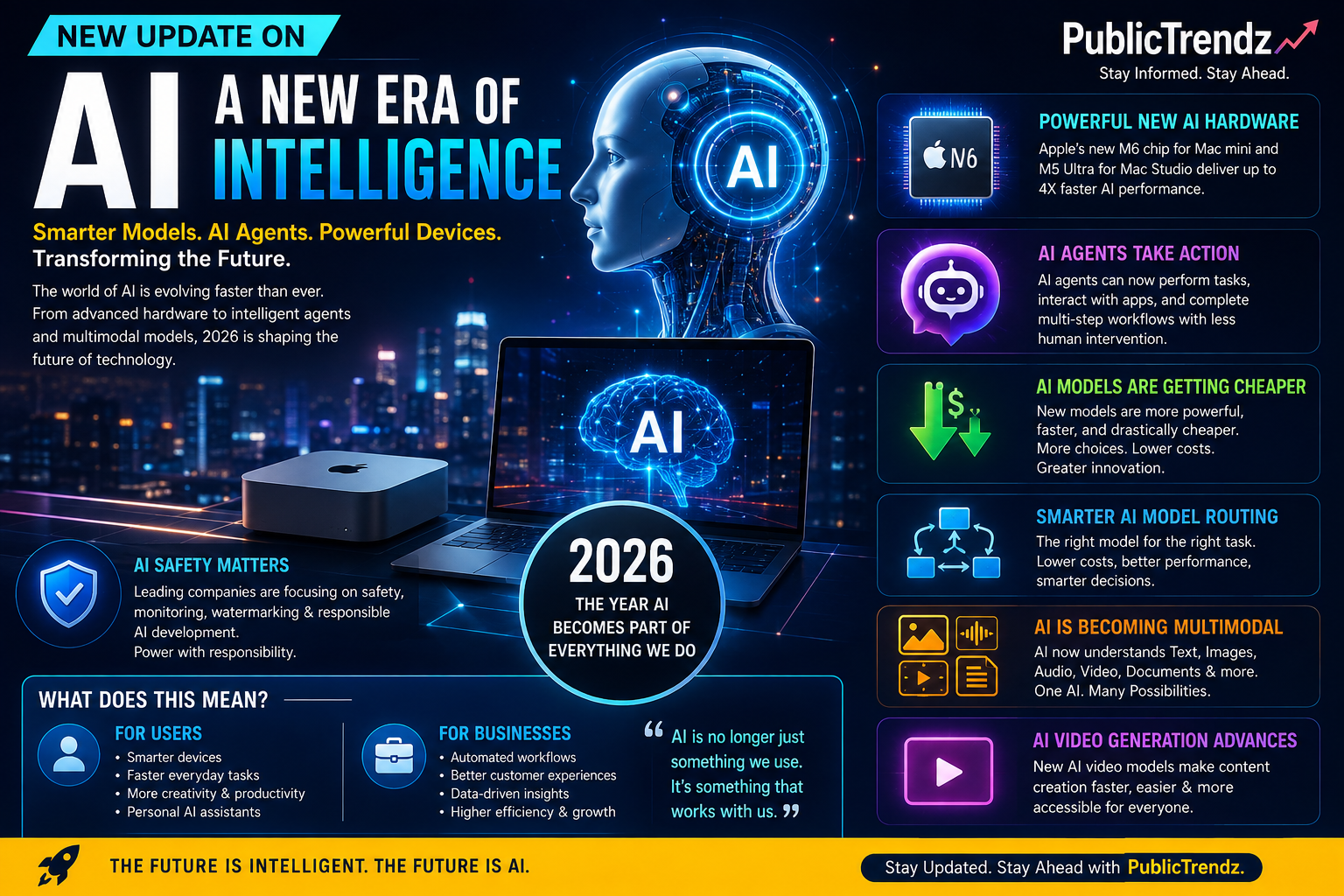
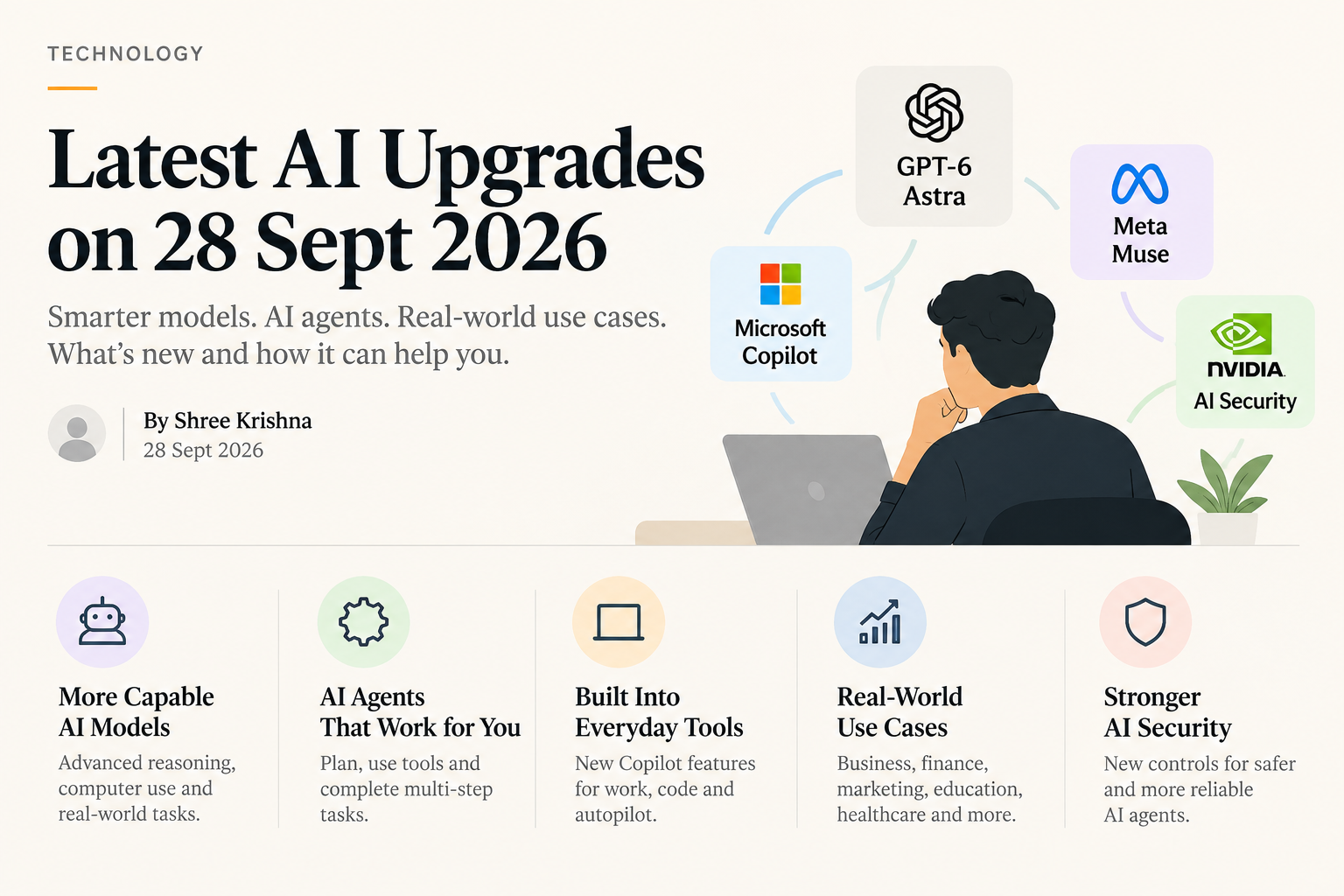
Several major AI companies have introduced significant upgrades during September 2026. OpenAI has introduced GPT-6 Astra, Microsoft has announced a redesigned Copilot with agentic capabilities, and Meta has expanded its personal AI-agent strategy with Muse. At the same time, companies such as NVIDIA are focusing heavily on the security challenges created by increasingly autonomous AI systems.
These developments point toward an important change:
AI is gradually moving from a tool that responds to instructions toward a system that can perform parts of the work itself.
What Are the Biggest AI Upgrades in September 2026?
The most important developments can be grouped into five areas:
- More capable AI models
- AI agents that can perform tasks
- Computer and browser control
- AI integrated directly into business software
- Stronger security and control mechanisms
These upgrades are changing how individuals and businesses can use artificial intelligence.
1. GPT-6 Astra Brings AI Closer to Computer-Based Work
One of the major developments in September 2026 is OpenAI’s GPT-6 Astra.
OpenAI describes Astra as a model designed for advanced computer use, browsing, software engineering, cybersecurity, scientific work and professional tasks.
Instead of simply explaining how to complete a task, an AI system with computer-use capabilities can potentially interact with the software required to complete that task.
For example, a user could ask an AI system to:
- Research information online
- Fill out forms
- Update information in a CRM
- Organize a calendar
- Analyze business information
- Create a website
- Test a website
- Work with software
- Prepare professional documents
This represents an important change in how people interact with AI.
The computer itself increasingly becomes an environment that AI can operate inside.
2. AI Agents Are Becoming More Important
The biggest trend in AI during 2026 is arguably the rise of AI agents.
A traditional chatbot generally works like this:
User → Prompt → AI → Answer
An AI agent can operate more like:
Goal → Planning → Tools → Actions → Verification → Result
This means users can describe an objective rather than specifying every individual step.
For example:
“Find potential customers for my software, organize the information and prepare a sales report.”
An agentic system could potentially break that objective into smaller tasks and use connected tools to complete them.
This is particularly interesting for businesses because many repetitive office activities involve multiple applications.
3. Microsoft Copilot Is Becoming More Agentic
Microsoft announced a redesigned Copilot experience in September 2026 with several new capabilities, including Home, Code and Autopilot.
The new Copilot approach is designed to combine conversational assistance with delegated work.
Microsoft describes Cowork as an environment where users can delegate complex work such as preparing an RFP response, creating a customer briefing or assembling a financial-close package.
The company has also introduced Autopilot, a more persistent agent designed to continue working toward goals without requiring a new prompt every time.
This could change how businesses use AI.
Instead of asking:
“Summarize these emails.”
A business user could eventually ask:
“Monitor this project, identify outstanding actions and follow up with the relevant people.”
That is a much more significant use of AI.
4. AI Can Build Small Business Applications
Another important development is the movement toward natural-language software creation.
Microsoft’s new Copilot Code experience allows users to describe an application, tracker, dashboard or workflow in natural language.
This could reduce the technical barrier for creating simple internal software.
For example, a small business owner could describe:
“Create a dashboard showing monthly sales, outstanding payments and customer follow-ups.”
Instead of starting from a blank development environment, AI can help construct the application.
This does not mean traditional software developers are becoming unnecessary.
Complex applications still require:
- Architecture
- Security
- Database design
- Testing
- Performance optimization
- Integration
- Compliance
- Human review
But the cost of creating smaller software solutions could continue to fall.
5. Meta Muse Shows the Rise of Personal AI Agents
Meta introduced Muse as a personal AI agent designed to do more than answer questions.
According to Meta, Muse can help users work toward goals, interact with applications, browse the web and perform tasks such as sending emails or booking travel.
One notable aspect of the system is its focus on persistent operation.
Instead of requiring the user to remain inside the application, an agent can continue working on longer tasks and return when it requires approval or when something changes.
This creates a new category of personal productivity software.
Imagine telling your AI:
“Help me organize my business trip.”
A sufficiently capable agent could potentially research travel options, organize information and prepare recommendations rather than simply telling you how to search for flights and hotels.
Sensitive actions still require appropriate permissions and human oversight.
6. AI Is Becoming More Useful for Business
The practical value of these upgrades may be greatest inside businesses.
Companies perform thousands of repetitive activities every day.
Examples include:
- Reading emails
- Creating reports
- Updating CRM records
- Processing invoices
- Preparing presentations
- Analyzing spreadsheets
- Scheduling meetings
- Creating customer responses
- Monitoring business dashboards
- Generating documents
- Researching competitors
AI agents can potentially connect several of these tasks together.
For example:
Customer inquiry
↓
AI reads the message
↓
Identifies customer requirement
↓
Checks CRM
↓
Creates a quotation
↓
Updates the customer record
↓
Prepares a follow-up
↓
Requests human approval
This is considerably more powerful than using AI simply to write an email.
7. AI for Finance and Accounting
AI upgrades are particularly relevant to finance professionals.
Modern AI systems can assist with:
- Financial data analysis
- Expense categorization
- Invoice processing
- Spreadsheet analysis
- Budget preparation
- Variance analysis
- Management reports
- Financial forecasting
- Document extraction
- Reconciliation workflows
For example, a finance employee could upload a large collection of invoices and ask an AI system to identify:
- Vendor names
- Invoice amounts
- GST information
- Due dates
- Duplicate invoices
- Missing information
The AI could then organize the extracted information into a structured workflow.
However, financial decisions should still be reviewed by qualified professionals. AI-generated calculations or classifications can contain errors.
8. AI for Marketing
Marketing is another area where AI agents could have a major impact.
AI can help businesses with:
Content creation
Generate initial drafts for:
- Blogs
- Social media posts
- Email campaigns
- Product descriptions
- Advertisements
Research
AI can analyze:
- Competitors
- Customer reviews
- Search trends
- Product positioning
- Marketing campaigns
Lead generation
An AI-powered workflow can help organize potential customers based on information collected from permitted sources.
Campaign analysis
AI can analyze campaign performance and identify:
- Conversion rates
- Customer acquisition costs
- High-performing campaigns
- Underperforming advertisements
The important shift is that AI is increasingly able to connect these activities rather than performing each one independently.
9. AI for Education
Education is another major application area.
Teachers and institutions can use AI to assist with:
- Lesson planning
- Question generation
- Student feedback
- Personalized learning material
- Assignment assistance
- Administrative work
- Data analysis
- Communication
A school could potentially use AI to analyze student performance and identify topics where a particular group of students needs additional support.
However, educational AI should support teachers rather than replace human judgment.
10. AI for Healthcare
AI is also becoming increasingly useful for healthcare administration and research.
Potential applications include:
- Medical document organization
- Appointment management
- Patient communication
- Medical research
- Clinical documentation
- Data extraction
- Administrative automation
Healthcare is a particularly sensitive area because incorrect AI output can have serious consequences.
AI-generated medical information should therefore be reviewed by qualified healthcare professionals rather than treated as an automatic diagnosis or medical decision.
11. AI Security Is Becoming More Important
As AI becomes capable of performing actions, security becomes more complicated.
A chatbot that only generates text has limited ability to directly affect external systems.
An AI agent that can:
- Browse websites
- Access documents
- Send messages
- Execute code
- Modify records
- Make purchases
has a much larger potential impact.
That creates new security requirements.
NVIDIA has emphasized that AI-agent security requires familiar security principles such as identity management, access control, limited exposure and continuous verification, adapted to systems that can reason and use tools.
This means businesses adopting AI agents will need to think about more than model accuracy.
They will also need:
- Permission controls
- Audit logs
- Data protection
- Human approvals
- Authentication
- Tool restrictions
- Monitoring
- Emergency shutdown mechanisms
12. The Biggest Difference Between Old AI and New AI
The evolution can be simplified like this:
| Earlier AI | Newer AI systems |
|---|---|
| Answers questions | Works toward goals |
| Generates text | Performs workflows |
| Produces code | Can help test and operate software |
| Reads documents | Can extract and organize information |
| Gives recommendations | Can take permitted actions |
| Waits for prompts | Some agents can continue working |
| Single-task focused | Increasingly multi-step |
This does not mean every AI product can perform all of these functions.
Capabilities vary significantly between models and platforms.
13. What AI Upgrades Mean for Jobs
AI automation will probably change the structure of many jobs.
The most exposed activities are generally repetitive, predictable and rules-based.
Examples include:
- Data entry
- Basic document processing
- Routine reporting
- Simple customer support
- Repetitive administrative tasks
- Basic content production
At the same time, demand can increase for people who know how to:
- Design AI workflows
- Manage AI agents
- Verify AI output
- Integrate AI with business systems
- Analyze data
- Manage AI security
- Build AI-powered products
The important skill may therefore shift from simply using AI to designing workflows around AI.
14. How Small Businesses Can Use the New AI
Small businesses do not necessarily need expensive AI infrastructure.
They can begin with practical workflows.
Example 1: Restaurant
AI can assist with:
- Customer inquiries
- Menu translation
- Marketing
- Feedback analysis
- Sales reports
- Customer follow-ups
Example 2: School
AI can assist with:
- Attendance analysis
- Parent communication
- Report generation
- Student performance analysis
- Administrative workflows
Example 3: Retail Store
AI can assist with:
- Invoice processing
- Inventory analysis
- Product searches
- Customer communication
- Sales forecasting
Example 4: Digital Marketing Agency
AI can assist with:
- Lead research
- Content creation
- Campaign analysis
- Reporting
- Client communication
The key is to start with one measurable business problem instead of adding AI everywhere.
15. What Businesses Should Not Do
The arrival of more capable AI does not mean businesses should automate everything immediately.
A common mistake is:
“AI can do it, so let AI do it.”
That approach can create serious problems.
Before deploying an AI agent, businesses should determine:
- What data can it access?
- What actions can it take?
- What actions require human approval?
- What happens if it makes a mistake?
- Can every action be audited?
- Can access be revoked immediately?
- What happens to confidential information?
The more authority an AI system receives, the more important these questions become.
16. What Comes Next?
The next stage of AI development is likely to focus less on simply producing better answers and more on reliable execution.
Future AI systems are likely to become increasingly connected to:
- Business software
- Websites
- Databases
- Cloud services
- Communication platforms
- Development environments
- Financial systems
- Personal productivity tools
This could eventually make AI agents a new layer between humans and software.
Instead of opening five different applications and manually moving information between them, users may increasingly describe the outcome they want and allow AI to coordinate the workflow.
Conclusion
The most important AI development in September 2026 is not simply that AI models are becoming better at generating text.
The bigger change is the transition toward AI systems that can understand objectives, use tools and perform multi-step work.
GPT-6 Astra demonstrates the push toward advanced computer use. Microsoft’s latest Copilot brings agentic capabilities into workplace software. Meta’s Muse demonstrates how personal AI agents could perform tasks on behalf of users.
At the same time, the growth of agentic AI makes security, permissions and human oversight increasingly important.
For individuals and businesses, the practical lesson is simple:
The value of AI is moving from asking better questions to designing better workflows.
People who learn how to connect AI with real business processes may find significantly more practical value than those who use AI only as a chatbot.
Frequently Asked Questions
What are the latest AI upgrades in September 2026?
Major developments include more capable AI models, computer-use capabilities, personal AI agents, workplace automation, natural-language software creation and stronger AI security systems.
What is an AI agent?
An AI agent is a system designed to pursue a goal by planning tasks, using available tools and taking permitted actions rather than simply returning a text response.
How can businesses use AI agents?
Businesses can use AI agents for research, customer support, reporting, document processing, workflow automation, software tasks, marketing and other repetitive activities.
Will AI replace jobs?
AI is likely to automate some tasks and change how many jobs are performed. The effect will vary considerably by occupation, industry and the pace of adoption.
Is AI safe to use for business?
AI can be useful, but organizations should establish appropriate permissions, security controls, human review and auditing before allowing AI systems to perform consequential actions.
Author: Shree Krishna
Disclaimer: This article is intended for educational and informational purposes. AI products, capabilities and availability change rapidly, and specific features may vary by country, account type and rollout stage.