
India Rebukes Pakistan at UN Over Jammu and Kashmir Remarks
India exercised its Right of Reply at the UN General Assembly's Fourth Committee, dismissing Pakistan's assertions on Jammu and Kashmir and calling out Islamabad for human rights violations.
News Desk · October 11, 2026 · 2 min read
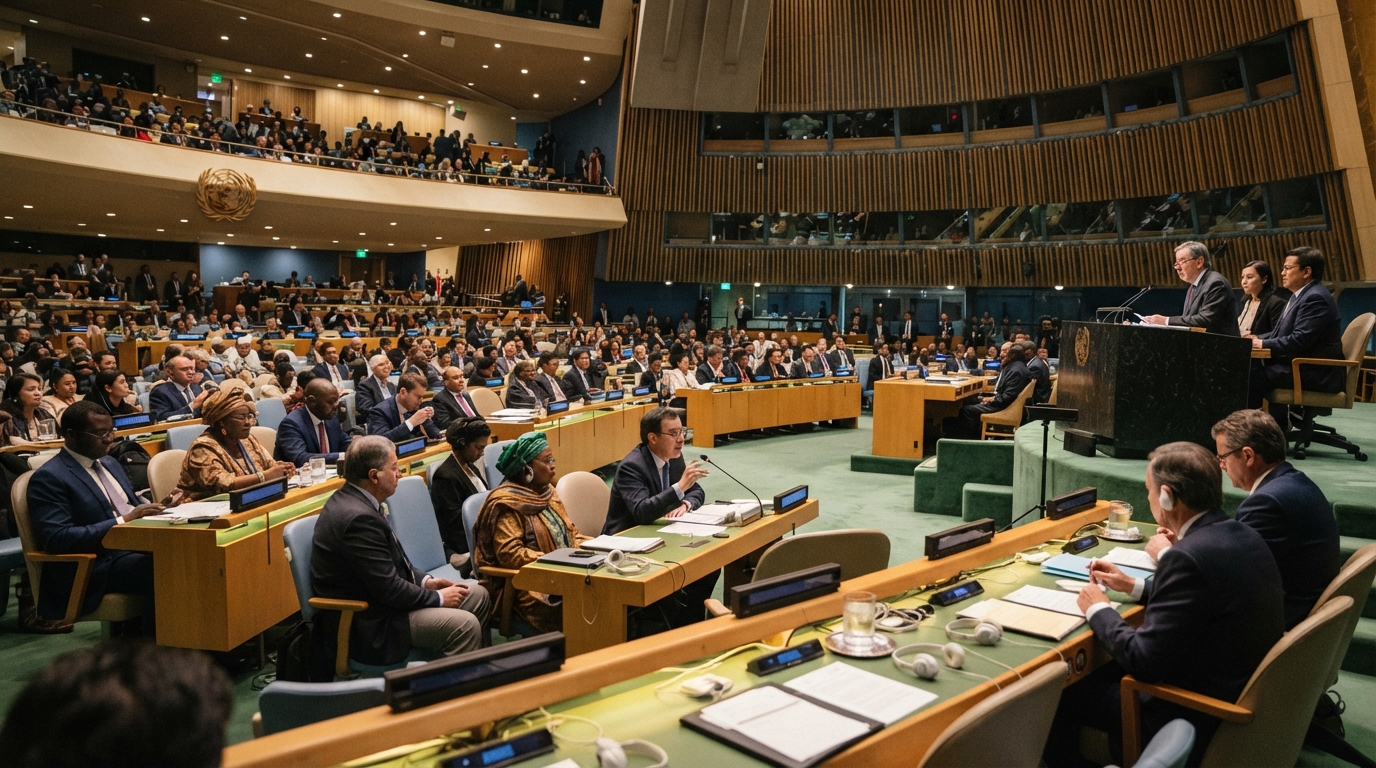

India sharply rebuked Pakistan at the United Nations General Assembly, stating that Islamabad continues to misuse international forums to spread falsehoods regarding the Union Territory of Jammu and Kashmir. Exercising its Right of Reply during a session of the Fourth Committee, Member of Parliament Mahima Kumari Mewar asserted that Jammu and Kashmir remains an integral and inalienable part of India.
The diplomatic exchange took place during committee deliberations centered on decolonisation. New Delhi's intervention came in direct response to comments made by the Pakistani representative, marking a continuation of sharp verbal sparring between the two neighboring nations at UN forums regarding territorial sovereignty and governance.
Addressing the assembly, the Indian delegation stated that it was unfortunate to witness the persistent abuse of the UN platform for political posturing. The statement emphasized that empty rhetoric from Islamabad cannot alter ground realities or the constitutional status of the Union Territory.
Turning the focus toward domestic conditions across the border, India accused Pakistani authorities and allied proxies of severe human rights violations in regions under Islamabad's occupation. The Indian representative noted that local populations in those territories face intense military control, suppression, and economic exploitation, leading to widespread public dissatisfaction.
Furthermore, the statement highlighted recent civil unrest, alleging that armed forces and proxies had targeted dozens of ordinary citizens who took to the streets to demand basic freedoms, essential supplies, and fundamental rights. New Delhi urged international scrutiny of these contested areas rather than external lectures.
Criticizing Pakistan's internal political track record, the Indian statement pointed to historical military regimes, manipulated electoral processes, the detention of prominent political figures, and the propagation of religious extremism. The delegation asserted that a nation with such governance credentials lacks the moral standing to offer advice on international platforms.
The diplomatic confrontation follows a series of recent exchanges between the two countries at various UN committees in New York and Geneva concerning security and counter-terrorism policies. Indian diplomats have consistently maintained that bilateral mechanisms remain stalled due to ongoing state support for cross-border militancy.