
GST in India: How Goods and Services Tax Benefits Small Businesses, Startups and Entrepreneurs
Public Trendz Desk
October 9, 2026 · 9 min read
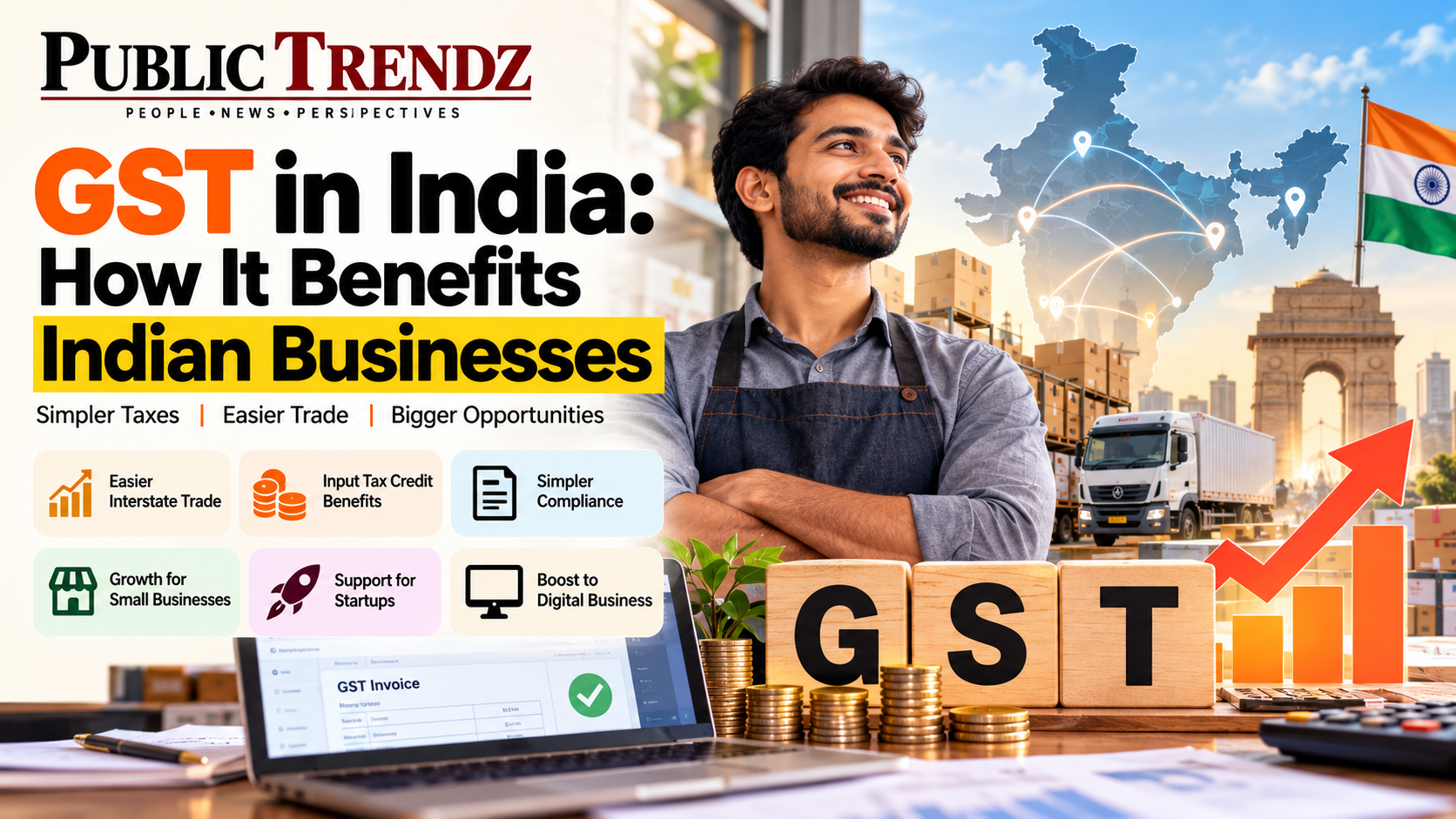

Starting and running a business in India involves several responsibilities, including managing sales, purchasing goods, maintaining accounts and paying taxes. For many business owners, understanding taxation can be one of the most challenging parts of running a company.
The introduction of Goods and Services Tax (GST) on July 1, 2017, brought a major change to India's taxation system. It replaced several indirect taxes with a more unified framework, making it easier for businesses to trade across different states.
Today, GST plays an important role in the operations of small shops, manufacturers, service providers, startups and large companies.
But what exactly is GST? How does it benefit Indian businesses? And why should entrepreneurs understand it before starting their business?
What Is GST?
GST stands for Goods and Services Tax. It is an indirect tax levied on the supply of goods and services in India.
Before GST was introduced, businesses dealt with different taxes, including Value Added Tax (VAT), service tax, excise duty and certain other state-level taxes.
This created difficulties for businesses operating in multiple states because different tax systems and procedures applied.
GST brought many of these taxes under a common structure.
The main objective was to create a more transparent taxation system, reduce the cascading effect of taxes and make business transactions easier.
GST is a destination-based tax, meaning the tax revenue generally belongs to the state or jurisdiction where goods or services are consumed.
Understanding the Different Types of GST
India primarily uses three types of GST.
--CGST (Central Goods and Services Tax)
CGST is collected by the Central Government on applicable transactions within a state.
--SGST (State Goods and Services Tax)
SGST is collected by the State Government on applicable transactions within the same state.
--IGST (Integrated Goods and Services Tax)
IGST generally applies to interstate supplies of goods and services, including certain import transactions.
For example, when a registered business in Karnataka sells taxable goods to a customer in Maharashtra, IGST generally applies.
When a business sells goods within Karnataka, CGST and SGST generally apply instead.
The applicable tax treatment depends on the nature of the supply and the relevant place-of-supply rules.
1. GST Makes Doing Business Across India Easier
One of the biggest benefits of GST is the creation of a more unified national market.
Before GST, businesses often faced different state-level indirect taxes and administrative requirements.
These differences could make transporting and selling goods across state borders more complicated.
Under GST, interstate transactions operate within a common tax framework.
For example, a clothing manufacturer in Bengaluru can supply products to retailers in Delhi, Mumbai or Hyderabad under the same broad GST system.
This has helped businesses expand their customer base beyond their home states.
For growing companies, easier interstate trade can create opportunities to reach new markets and build distribution networks.
2. Input Tax Credit Helps Reduce Business Tax Costs
One of the most important features of GST is Input Tax Credit, commonly known as ITC.
Input Tax Credit allows eligible registered businesses to use GST paid on business purchases to offset GST payable on their taxable sales, subject to legal conditions.
Consider a simple example.
A business purchases eligible goods worth ₹10,000 and pays ₹1,800 as GST at an assumed rate of 18%.
Later, the business sells those goods for ₹15,000 and charges ₹2,700 as GST at the same rate.
If the purchase qualifies for full ITC, the business can adjust the ₹1,800 already paid against its ₹2,700 output tax liability.
The remaining GST liability would be ₹900.
This mechanism helps reduce the cascading effect of taxes and prevents eligible businesses from bearing tax repeatedly at different stages of the supply chain.
However, not every business expense qualifies for ITC. Eligibility depends on the type of purchase, documentation, supplier compliance and other GST conditions.
3. GST Can Help Small Businesses Become More Professional
GST registration can encourage businesses to maintain proper invoices, purchase records and sales accounts.
For a small business owner, organised financial records can provide several advantages.
They can help the owner understand monthly turnover, identify profitable products, monitor expenses and prepare financial statements.
A registered business can also issue GST-compliant tax invoices when applicable.
This is particularly useful when dealing with larger companies that require proper tax documentation from their suppliers.
However, GST registration alone does not guarantee business credibility or customer trust. Good service, reliable products and honest business practices remain equally important.
4. GST Supports Startups and Growing Businesses
India has seen growing interest in entrepreneurship, with individuals launching online stores, technology businesses, consulting services and digital agencies.
For these startups, understanding GST is an important part of financial planning.
A business that maintains proper invoices and tax records may find it easier to organise its accounts and manage transactions with corporate clients.
GST registration may also help eligible businesses work with buyers that prefer registered suppliers.
For example, a digital marketing agency providing design and advertising services can issue proper tax invoices to registered business clients.
Where permitted, eligible clients may claim Input Tax Credit on those purchases.
This can make GST-compliant transactions commercially useful for both parties.
5. GST Encourages Digital Record-Keeping
GST has contributed to the growth of digital accounting and online tax compliance in India.
Businesses can use the GST portal and accounting software to maintain invoices, review tax information and prepare returns.
Digital tools can reduce manual paperwork and improve record accuracy when used correctly.
Today, many business owners use billing and accounting systems to track sales, purchases, expenses, inventory and GST liabilities.
For small retailers and service providers, these tools can provide a clearer picture of business performance.
However, software does not automatically guarantee compliance. Business owners must still ensure that invoices, classifications and tax calculations are accurate.
6. GST Helps Businesses Expand Through E-Commerce
Online selling has created opportunities for Indian businesses to reach customers across the country.
A small clothing seller in Bengaluru can now market products to buyers in Chennai, Pune, Kolkata or other cities using websites and online marketplaces.
GST provides a common indirect-tax structure for these transactions.
At the same time, online sellers must understand the registration and compliance rules relevant to their business model.
Certain e-commerce activities have special requirements, while specific exemptions and simplified procedures may apply to eligible sellers.
Therefore, entrepreneurs should verify the applicable rules before beginning interstate or marketplace sales.
7. GST Registration: Does Every Small Business Need It?
A common misunderstanding is that every small business in India must obtain GST registration immediately.
In reality, registration requirements depend on factors such as annual aggregate turnover, the nature of business, location and whether compulsory registration provisions apply.
For many eligible businesses dealing exclusively in goods, the turnover-based exemption threshold can be ₹40 lakh in applicable states.
For many service providers, the general threshold is ₹20 lakh, with lower thresholds applying in certain states.
However, these limits are not universal.
Some suppliers may be required to register regardless of turnover, while other businesses may qualify for specific exemptions.
Business owners should confirm the rules applicable to their activities rather than assuming that a single threshold applies to every business.
8. The Composition Scheme Can Simplify Compliance
GST also offers a Composition Scheme for certain eligible small taxpayers.
Under this arrangement, qualifying businesses can pay tax at prescribed rates on turnover and follow a simplified compliance framework.
This may reduce some administrative responsibilities.
However, composition taxpayers generally cannot collect GST separately from customers or claim regular Input Tax Credit.
The scheme also has eligibility conditions and restrictions.
Therefore, the Composition Scheme is not automatically the best option for every small business.
Businesses should compare the advantages and limitations before choosing it.
9. GST Reforms in 2025 and 2026
India's GST system continues to evolve.
In September 2025, the GST Council approved major rate rationalisation measures designed to simplify the tax structure.
The reforms introduced a broader two-rate structure centred on 5% and 18%, alongside a special 40% rate for selected goods and services, with exemptions and other applicable provisions.
The objective was to reduce complexity and make taxation more predictable.
More recently, at the 57th GST Council meeting in October 2026, additional measures were announced to improve business compliance, registration, refunds and dispute resolution.
The reforms include steps towards greater automation, simpler procedures for eligible small businesses and a reduction in certain punitive enforcement provisions.
Several of these changes are expected to be implemented in phases, including measures scheduled from April 2027.
For businesses, the direction of these reforms is important because faster refunds and simpler compliance procedures can help reduce administrative burdens and improve working capital management.
However, announced reforms should not be treated as legally effective until the necessary notifications and implementation requirements are in place.
10. Challenges Businesses Still Face Under GST
Although GST offers several benefits, it also creates responsibilities for registered taxpayers.
Small business owners may find it difficult to understand return filing, tax classification, Input Tax Credit reconciliation and invoice requirements.
Late filing, incorrect reporting and documentation errors can lead to additional costs, interest or penalties where applicable.
Businesses may also experience working capital pressure when tax payments are due before customers settle their invoices.
For this reason, entrepreneurs should maintain accurate records and regularly review their GST compliance.
Professional advice from a qualified tax practitioner or chartered accountant can be particularly useful for businesses with complex transactions.
-- Why GST Knowledge Is Important for Every Entrepreneur
Whether someone operates a retail shop, restaurant, clothing brand, manufacturing unit, digital marketing agency or software company, taxation plays an important role in financial management.
Understanding GST helps business owners calculate selling prices, maintain proper accounts, manage eligible Input Tax Credit and plan tax payments.
It can also prevent avoidable mistakes during business expansion.
Entrepreneurs who understand the basics of GST are better prepared to make informed decisions about invoicing, purchases, pricing and customer transactions.
GST should therefore be viewed not only as a tax compliance requirement but also as an important part of responsible business management.
--Conclusion: GST Is an Important Part of India's Business Growth
Since its introduction in 2017, GST has become a central part of India's indirect taxation system.
By creating a common tax framework, allowing eligible Input Tax Credit and encouraging digital compliance, it has helped modernise the way businesses operate.
The benefits are particularly relevant to small businesses and startups seeking to expand beyond local markets.
At the same time, GST compliance requires accurate records, an understanding of applicable rules and careful financial planning.
Recent reforms show that the system continues to change as the government works towards simpler procedures and improved ease of doing business.
For Indian entrepreneurs, learning how GST works is an essential step towards building a sustainable and professionally managed business.
A successful business needs more than customers and sales. It also needs proper financial management, transparent records and a clear understanding of its tax responsibilities.
---
**Disclaimer: This article is intended for general information and educational purposes. GST rates, registration thresholds, exemptions and compliance requirements may vary according to business activities and applicable notifications. Readers should refer to official GST publications or consult a qualified tax professional before making tax-related decisions.
Sources: Central Board of Indirect Taxes and Customs (CBIC), GST Council, Government of India, and publicly reported updates from the 56th and 57th GST Council meetings.