
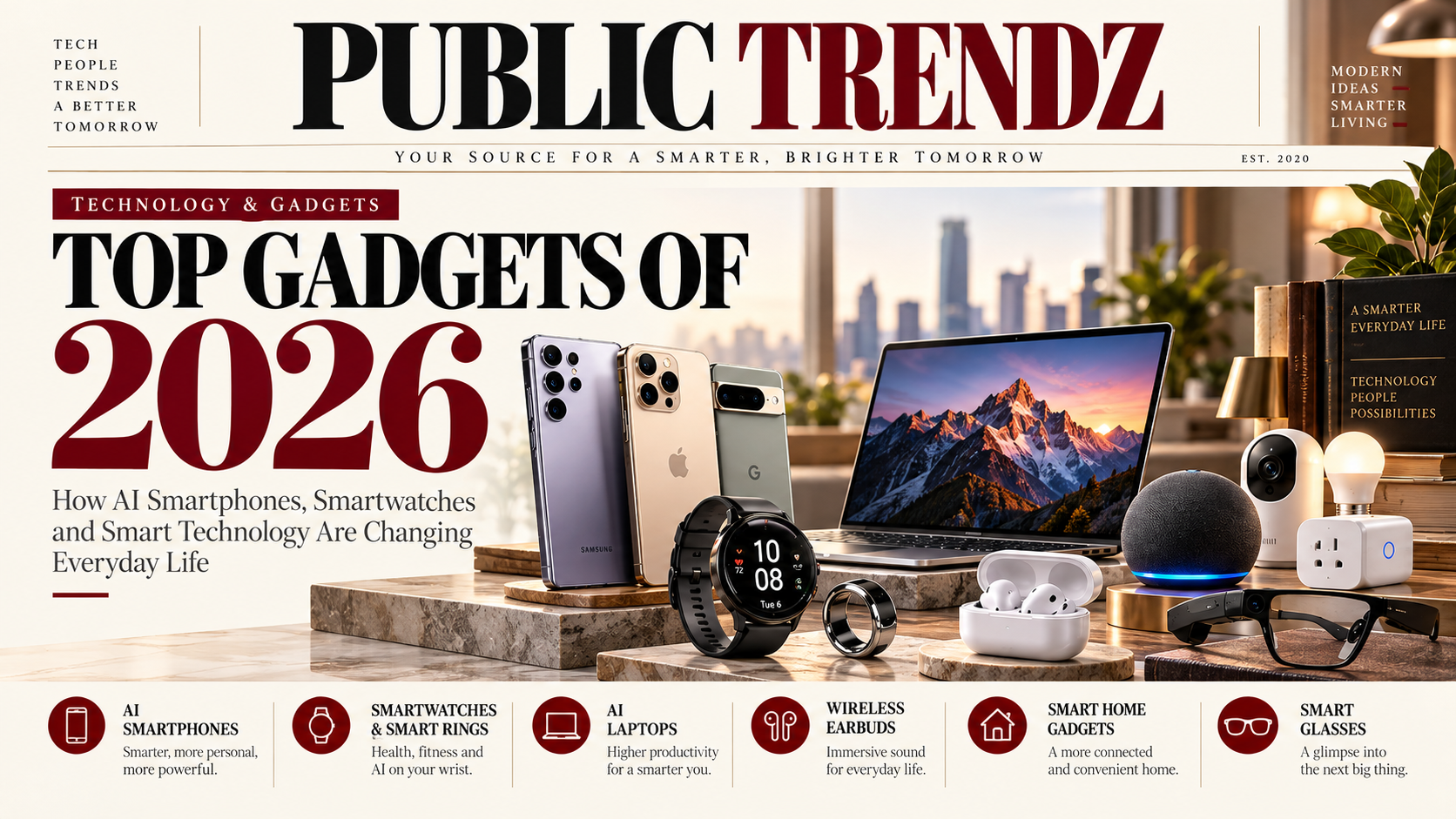

Technology is evolving faster than ever, and 2026 is bringing significant changes to the gadgets we use every day. From smartphones powered by artificial intelligence to smartwatches that monitor health and laptops designed for demanding work, modern devices are becoming increasingly intelligent and convenient.
A few years ago, people mainly purchased smartphones for calling, messaging, photography and browsing the internet. Today, smartphones can translate conversations, summarise lengthy documents, assist with writing and enhance photographs.
Similarly, smartwatches have progressed beyond displaying notifications, while laptops are being equipped with dedicated artificial intelligence processors.
But with hundreds of gadgets available in the market, one important question remains: Which gadgets are actually worth buying in 2026?
Let us explore the major gadget categories, their practical advantages, approximate prices in India and the features consumers should consider before purchasing.
1. AI Smartphones: A New Generation of Mobile Technology
Smartphones are among the most widely used electronic devices in India. Whether someone is a student, employee, business owner or content creator, a smartphone has become an essential daily companion.
In 2026, artificial intelligence is one of the major areas of smartphone development.
Important features of modern AI smartphones:
AI-powered photo editing and object removal
Live translation and transcription
Intelligent writing assistance
Voice-based AI assistants
Advanced camera processing
Automatic summarisation of selected documents and conversations
Improved battery and performance management
Popular smartphone manufacturers, including Apple, Samsung, Google, Xiaomi and OnePlus, offer AI-related features on selected devices.
However, AI capabilities vary considerably between models. Some functions operate directly on the phone, while others require an internet connection or cloud processing.
AI Smartphone Price Comparison in India
Smartphone Category | Approximate Price | Suitable For |
|---|---|---|
Budget Smartphones | ₹8,000–₹15,000 | Basic everyday use |
Mid-Range Smartphones | ₹15,000–₹30,000 | Students and regular users |
Upper Mid-Range Smartphones | ₹30,000–₹50,000 | Photography and multitasking |
Premium Smartphones | ₹50,000–₹80,000 | Professionals and creators |
Flagship Smartphones | ₹80,000–₹1,50,000+ | Advanced photography and demanding tasks |
Note: These are broad illustrative price ranges, not live quotations. Actual prices and AI features depend on the brand, model and retailer.
Buying advice: Instead of choosing a smartphone based only on advertised AI features, check battery life, camera performance, software-update policies, warranty and availability of authorised service centres.
2. Smartwatches: Your Everyday Fitness Companion
Smartwatches have become popular among people interested in fitness, health monitoring and convenient smartphone notifications.
A modern smartwatch can track steps, monitor heart rate, estimate calories burned, analyse sleep patterns and record different types of physical activity.
Some advanced models also include ECG capabilities, irregular-heart-rhythm notifications and other specialised features.
Smartwatch Features and Their Benefits
Feature | Practical Benefit |
|---|---|
Heart Rate Monitoring | Tracks heart rate trends |
Step Counter | Monitors daily movement |
Sleep Tracking | Estimates sleep duration and patterns |
Workout Tracking | Records selected exercises |
GPS | Supports outdoor activity tracking |
Calling and Notifications | Improves daily convenience |
ECG on Supported Models | Provides recordings that may support medical discussions |
A basic fitness smartwatch may cost approximately ₹1,500–₹5,000, while advanced products from established brands can cost ₹20,000–₹60,000 or more.
Smart rings are also attracting attention. These smaller wearables can track selected wellness indicators without requiring users to wear a conventional smartwatch.
Important: Wearable health measurements are not always accurate and should not replace professional medical assessment.
3. AI Laptops: Smarter Computers for Work and Education
Laptops are becoming more capable as manufacturers introduce processors with dedicated neural processing units, commonly called NPUs.
These processors are designed to accelerate supported AI workloads, potentially reducing reliance on external cloud services.
For students and professionals, AI-enabled laptops can be useful for document processing, video meetings, image editing and productivity applications.
However, purchasing an AI-branded laptop does not automatically guarantee better overall performance.
Laptop Categories and Approximate Prices
Laptop Type | Approximate Price | Recommended For |
|---|---|---|
Entry-Level Laptop | ₹25,000–₹40,000 | Browsing and basic office work |
Student Laptop | ₹40,000–₹60,000 | Education and assignments |
Productivity Laptop | ₹55,000–₹90,000 | Office work and multitasking |
Creator Laptop | ₹80,000–₹1,50,000 | Editing, design and content creation |
Premium / AI Workstation | ₹1,20,000–₹2,50,000+ | Demanding professional workloads |
These are indicative market segments rather than prices for specific models.
Before buying, pay close attention to processor performance, RAM, SSD capacity, display quality, battery life, cooling and after-sales support.
For many users, a reliable laptop with 16GB RAM and sufficient SSD storage may be more valuable than a model with advanced AI marketing but limited basic specifications.
4. Wireless Earbuds: Better Sound and Smarter Communication
Wireless earbuds are no longer used only for listening to music.
Many modern earbuds include active noise cancellation, environmental noise reduction, improved microphones and adaptive sound settings.
Premium devices may integrate with voice assistants or provide additional functions through compatible smartphones.
Wireless Earbuds Buying Guide
Price Range | Typical Features | Best For |
|---|---|---|
₹500–₹1,500 | Basic wireless audio | Occasional use |
₹1,500–₹3,000 | Improved battery and microphones | Students |
₹3,000–₹7,000 | Noise cancellation on selected models | Everyday commuters |
₹7,000–₹15,000 | Higher-quality audio and features | Frequent callers |
₹15,000+ | Premium noise cancellation and ecosystem integration | Enthusiasts and professionals |
When choosing earbuds, buyers should prioritise comfort, microphone performance, battery life and dependable connectivity.
Premium earbuds are not automatically necessary for everyone. An affordable, comfortable pair may be sufficient for calls, online classes and everyday entertainment.
5. Smart Home Gadgets: Turning Ordinary Homes Into Connected Homes
Smart home technology is another growing category.
Connected devices can help people control selected household appliances, monitor security and automate everyday tasks.
Examples include smart bulbs, smart plugs, smart speakers, security cameras, video doorbells and robot vacuum cleaners.
Popular Smart Home Gadgets
Gadget | Main Purpose | Approximate Price |
|---|---|---|
Smart Bulb | App-controlled lighting | ₹400–₹2,000 |
Smart Plug | Scheduling compatible appliances | ₹600–₹2,000 |
Smart Speaker | Voice commands and audio | ₹3,000–₹12,000 |
Wi-Fi Security Camera | Home monitoring | ₹1,500–₹6,000 |
Video Doorbell | Visitor monitoring | ₹3,000–₹15,000 |
Robot Vacuum Cleaner | Automated floor cleaning | ₹12,000–₹60,000+ |
Prices are illustrative and depend on features and brands.
Smart home devices can improve convenience, but buyers should also consider cybersecurity.
Products should receive regular software updates, and users should protect connected accounts using strong passwords and available security features.
6. Smart Glasses: Could They Become the Next Big Gadget?
Smart glasses are an emerging product category combining cameras, speakers, microphones and, in selected products, artificial intelligence assistants.
Some models can capture photographs, record short videos, play audio and respond to voice commands.
Future improvements could make these devices more useful for navigation, accessibility and contextual assistance.
However, smart glasses are not yet a complete replacement for smartphones.
Battery limitations, privacy concerns, comfort and the availability of useful applications remain important challenges.
Consumers should also respect local rules and the privacy of people around them when using devices capable of recording video or audio.
7. Which Gadgets Are Most Useful for Different People?
Not everyone needs the same technology.
A college student may benefit more from a dependable laptop than an expensive smartwatch. A content creator may require a high-quality camera phone, while a business professional might value a laptop with good battery life and reliable video-call performance.
Gadgets Based on User Requirements
User Category | Useful Gadgets | Main Advantage |
|---|---|---|
Students | Laptop, earbuds, smartphone | Learning and assignments |
Office Employees | Laptop, earbuds, smartwatch | Productivity and communication |
Content Creators | Camera smartphone, laptop, microphone | Content production |
Business Owners | Smartphone, laptop, security camera | Business management |
Fitness Enthusiasts | Smartwatch, fitness tracker | Activity monitoring |
Families | Smart TV, smart speaker, security devices | Entertainment and convenience |
Travellers | Smartphone, power bank, earbuds | Navigation and communication |
8. Budget vs Premium Gadgets: Is Spending More Worth It?
Many consumers assume that expensive devices always provide a better experience.
In reality, premium products often include features that some users rarely need.
For example, a person using a smartphone primarily for calls, messaging, online payments and watching videos may not benefit significantly from buying a flagship phone.
Similarly, an expensive laptop designed for demanding creative work may be unnecessary for someone who mainly uses spreadsheets and web browsers.
Budget vs Premium Gadget Comparison
Factor | Budget Gadgets | Premium Gadgets |
|---|---|---|
Purchase Cost | Lower | Higher |
Performance | Suitable for common tasks | Often stronger for demanding tasks |
Materials | Generally simpler | Often higher-end construction |
Advanced Features | Limited or selective | More extensive |
Camera / Audio Quality | Varies by model | Often better, but not always |
Long-Term Value | Depends on support and durability | Depends on support and actual usage |
Best Choice | Cost-conscious everyday users | Users needing specific advanced capabilities |
A high price does not guarantee long-term reliability. Software support, repairs and product quality should always be considered.
9. Things to Check Before Buying Any Gadget in 2026
With online sales, exchange offers and promotional advertisements, buying electronic devices has become easier than ever.
However, consumers should avoid rushing into purchases.
Gadget Buying Checklist
What to Check | Why It Matters |
|---|---|
Actual Requirements | Prevents unnecessary spending |
Product Reviews | Highlights potential strengths and weaknesses |
Warranty | Protects against covered defects |
Software Updates | Supports security and compatibility |
Battery Life | Affects daily convenience |
Service Centres | Makes repairs easier |
Replacement Parts | Improves long-term usability |
Total Cost | Includes accessories and subscriptions |
Data Privacy | Helps protect personal information |
Consumers should compare prices across reputable sellers and review return policies before placing orders.
It is also wise to be cautious about unusually large discounts and unverified online sellers.
10. The Future of Gadgets Beyond 2026
The future of consumer technology is likely to involve stronger integration between artificial intelligence, connected devices and personal computing.
Smartphones may become more proactive in helping users organise daily activities. Laptops may perform more sophisticated AI tasks directly on-device, while wearable technology could provide more detailed personal activity insights.
Smart home systems may also become more capable of coordinating multiple devices automatically.
However, greater technological sophistication will bring challenges involving data privacy, repairability, environmental sustainability and electronic waste.
Manufacturers will need to demonstrate that new features deliver genuine value rather than simply encouraging frequent upgrades.
Frequently Asked Questions
1. Which gadget is most useful in 2026?
For most people, a reliable smartphone remains one of the most useful gadgets because it supports communication, payments, navigation, education and entertainment.
2. Are AI smartphones worth buying?
They can be useful for people who regularly need translation, writing assistance, editing or other supported AI features. However, buyers should verify which features are available on the specific model.
3. What is a good budget for a smartphone in India?
Many users can find suitable options in the ₹15,000–₹30,000 segment, although the right budget depends on individual requirements.
4. Are smartwatches accurate for health monitoring?
Smartwatches can provide useful activity and wellness trends, but accuracy varies. They should not replace medical advice or diagnostic equipment.
5. Should students buy an AI laptop?
Students should first prioritise performance, RAM, battery life and software compatibility. Dedicated AI hardware is useful only when it supports applications they intend to use.
6. Are smart home gadgets safe?
They can be used safely with appropriate precautions, including regular updates, strong passwords and purchases from manufacturers with reliable security support.
7. Is it better to buy budget or premium gadgets?
Budget gadgets are often sufficient for everyday needs. Premium devices become worthwhile when their additional capabilities solve specific problems for the buyer.
Conclusion: Choose Technology That Adds Real Value
Gadgets are becoming smarter, faster and more connected. Artificial intelligence is improving what smartphones, laptops and other devices can accomplish, while wearable and smart home technologies are changing everyday routines.
But technological advancement does not mean everyone must purchase the latest device.
The most important consideration is whether a gadget improves productivity, supports a useful activity or makes life more convenient.
A well-chosen budget smartphone can sometimes deliver greater practical value than an expensive flagship. Similarly, a reliable laptop can remain useful for several years without requiring frequent replacement.
As the gadget industry continues to develop, consumers should focus on functionality, reliability, security and long-term value.
The future belongs not simply to people who own the latest technology, but to those who know how to use technology wisely.
Written by Shree Krishna R for Public Trendz.
Disclaimer: Product price ranges mentioned in this article are illustrative estimates. Actual prices, availability and specifications may vary across manufacturers, retailers and locations.