
Bengaluru anchors national push in battery storage and EV manufacturing growth
Bengaluru is consolidating its position as a primary national center for electric vehicle manufacturing and battery energy storage systems, backed by major industrial investments and state policy frameworks.
News Desk · October 8, 2026 · 2 min read
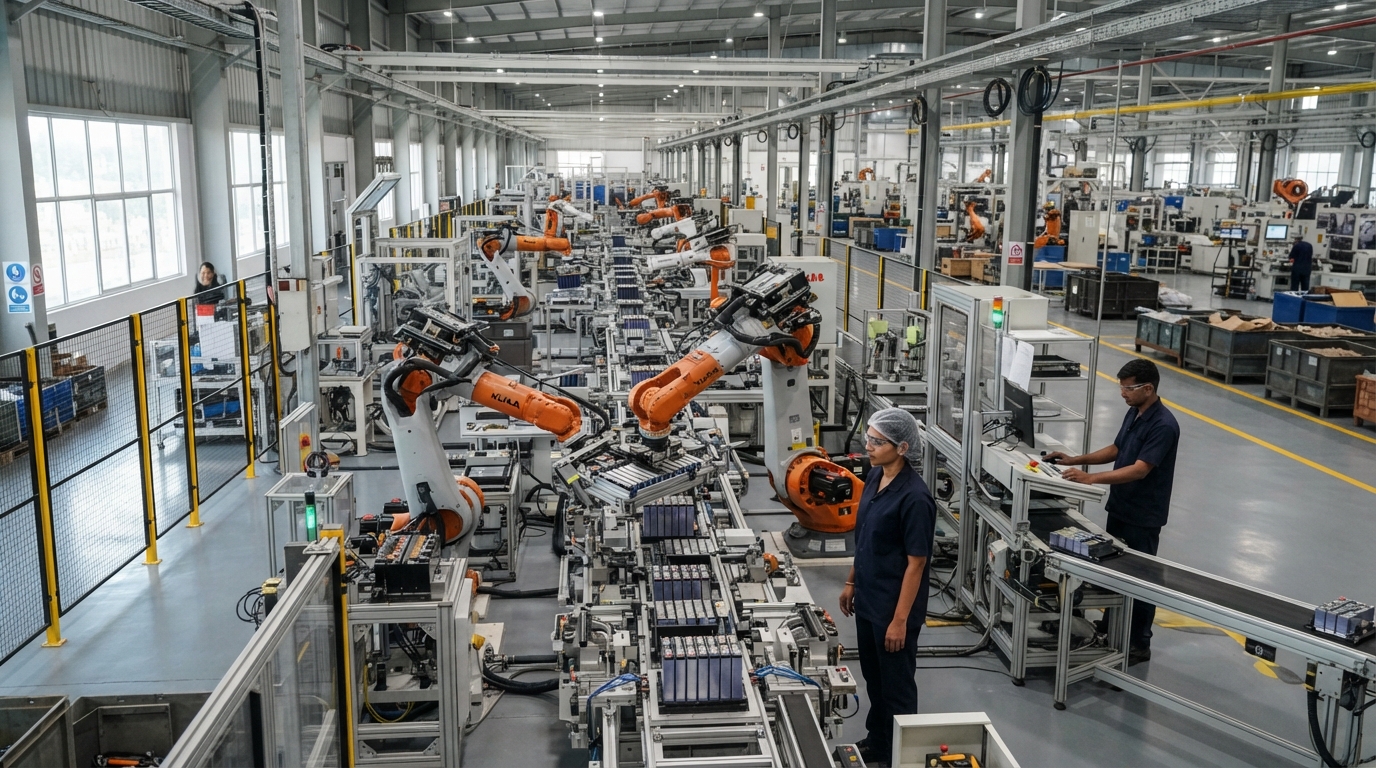

Bengaluru has emerged as a central operational node for India's scaling electric vehicle manufacturing and grid-scale battery energy storage sectors, drawing substantial industrial investments and policy backing. Industry participants and sector analysts meeting in the city pointed to a convergence of advanced engineering talent, research output from premier institutions, and targeted state policies driving domestic manufacturing capabilities.
The strategic consolidation comes as the central government pushes to integrate renewable energy generation with heavy-duty transmission infrastructure, supported by a ₹50,000-crore incentive scheme designed to deploy 50 gigawatt-hours of battery energy storage systems. Energy planners note that matching renewable capacity additions with grid stability requires advanced power electronics, smart-grid technologies, and domestic cell fabrication.
Industrial footprint expansion in the region has accelerated significantly over recent quarters. Exide Industries expanded its lithium-ion cell manufacturing footprint through its subsidiary, Exide Energy Solutions Limited, injecting ₹450 crore in early 2026 and bringing cumulative capital allocation in its greenfield gigafactory at Devanahalli in Bengaluru to over ₹5,200 crore. The facility completed the commissioning of its Phase-I 6 gigawatt-hour manufacturing block to cater to two-wheeler, three-wheeler, and four-wheeler vehicle segments alongside stationary storage.
Similarly, Midwest Energy inaugurated a 1.2 gigawatt-hour integrated cell-to-container manufacturing facility in the city to produce battery modules, trays, and racks for commercial and utility-scale applications. Industry leaders at a recent sector roundtable noted that such industrial build-outs are vital to mitigate supply chain risks and reduce reliance on imported components from overseas markets.
At the state level, the Karnataka Clean Mobility Policy targets ₹50,000 crore in investments by 2030, alongside the creation of specialized clean mobility clusters such as a 700-acre industrial hub at Harohalli near Bengaluru. The Karnataka Industrial Areas Development Board is establishing plug-and-play infrastructure across these designated zones to expedite factory setups for battery pack assemblers and original equipment manufacturers.
Public utility initiatives are complementing commercial investments. The Bangalore Electricity Supply Company deployed a pilot solar-powered charging hub near Kempegowda International Airport integrating second-life electric vehicle batteries for stationary energy storage. The installation uses retired lithium-ion cells to store 100 kilowatt-hours of energy, demonstrating a circular economy approach to manage peak urban grid loads.
Market analysts indicate that the subsequent growth phase will depend on domestic supply chain localization and cost parity with internal combustion engines. Sector stakeholders will monitor upcoming corporate earnings and industrial capacity utilization reports as manufacturing lines transition to full commercial output over the next two quarters.