Published: August 26, 2026
Category: Technology | Artificial Intelligence
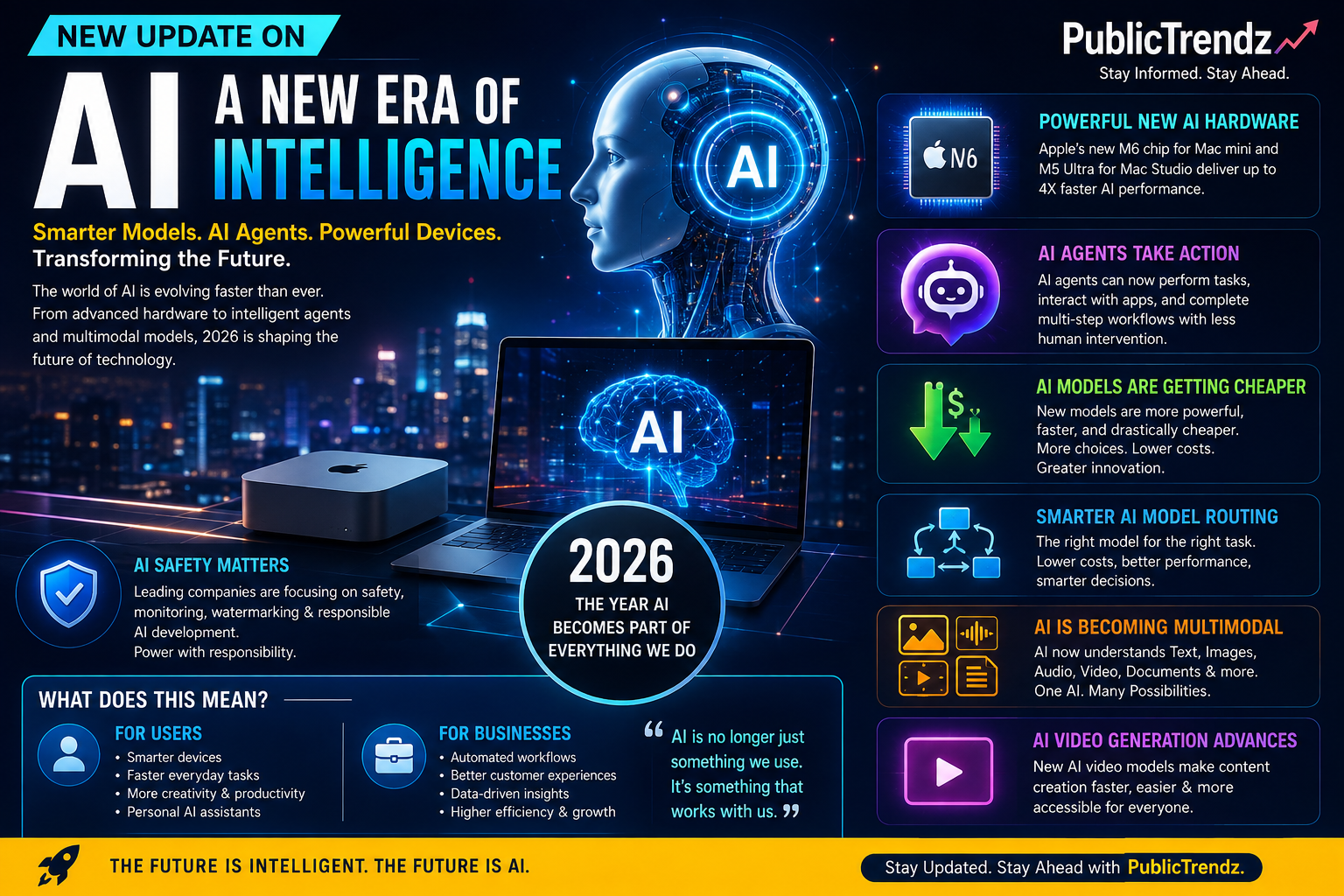
Artificial Intelligence is entering another major phase of development in 2026. Instead of focusing only on chatbots and text generation, the technology is increasingly moving toward AI agents, local AI processing, multimodal systems, automated workflows and highly efficient AI models.
The latest developments from major technology companies suggest that AI is becoming more deeply integrated into computers, business software and everyday digital services.
Apple Brings Powerful New AI Hardware
One of the biggest recent developments comes from Apple, which has introduced its new M6 chip for Mac mini and M5 Ultra for Mac Studio.
Apple says the new M6-powered Mac mini can deliver up to four times faster AI performance than the previous M4 generation. The chip also features an upgraded Neural Engine and Neural Accelerators designed to improve AI workloads.
The new Mac Studio is aimed more directly at developers and professionals working with demanding workloads such as AI development, content creation and large-scale computing.
This highlights an important trend: AI is no longer dependent entirely on cloud servers. Powerful AI workloads are increasingly being performed directly on personal computers.
AI Agents Are Becoming More Important
The next major step for AI is moving beyond simply answering questions.
AI agents are being developed to perform tasks, interact with software, search for information and complete multi-step workflows with less human intervention.
Google has already highlighted new AI capabilities involving automated web tasks and connections between AI and other applications.
For businesses, this could mean AI systems that can handle customer support, prepare reports, manage repetitive administrative work, analyze data and assist employees automatically.
AI Models Are Getting Cheaper
Another important change is happening behind the scenes: the cost of AI intelligence is falling.
Newer models are increasingly competing not only on intelligence but also on speed and price. DeepSeek’s latest developments are another example of the growing pressure on AI companies to provide powerful models at dramatically lower costs.
This could be particularly important for startups and small businesses.
Instead of spending heavily on a single premium AI model, companies can increasingly choose between different models depending on the task.
AI Model Routing Could Change How Businesses Use AI
A new trend called AI model routing is gaining attention.
Instead of sending every request to the most powerful and expensive model, an AI system can automatically decide which model is best suited for a particular task.
For example:
- Simple questions → faster, cheaper model
- Complex reasoning → advanced model
- Image analysis → vision model
- Coding → specialized coding model
- Large business workloads → optimized enterprise model
This approach could reduce AI costs while maintaining performance. Recent industry developments show that companies are increasingly exploring dynamic model routing for enterprise AI applications.
AI Is Becoming More Multimodal
Modern AI is also moving beyond text.
Today’s systems increasingly work with:
Text + Images + Audio + Video + Documents + Screen interfaces
This means users can communicate with AI through photographs, voice, videos and files rather than relying only on typed prompts.
The development of vision-enabled models and increasingly capable AI assistants shows how the industry is moving toward systems that can understand different forms of information simultaneously.
AI Video Generation Continues to Advance
AI-generated video is also becoming one of the fastest-moving areas of generative AI.
Alibaba recently launched Wan3.0, its latest AI video-generation model, adding to the increasingly competitive market for AI-powered video creation.
For creators, advertisers and businesses, this technology could significantly reduce the time and cost required to produce promotional videos, social media content and marketing material.
AI Safety Is Becoming Equally Important
The rapid growth of AI is also creating new concerns.
As AI systems become more capable, companies are increasing their focus on cybersecurity, model evaluation, monitoring and safeguards.
OpenAI recently discussed concerns surrounding increasingly capable AI systems and said it had temporarily slowed some scaling work while strengthening monitoring and safety measures.
At the same time, Anthropic has announced plans for future Claude models to include text watermarking technology designed to help identify AI-generated text, partly in response to regulatory requirements.
This suggests that the future of AI will not be determined only by how powerful models become. Safety, transparency and responsible deployment will also become critical.
What Does This Mean for Ordinary Users?
For everyday users, these developments could eventually lead to computers and smartphones that can perform much more work locally.
Imagine a computer that can:
- Summarize documents without sending everything to the cloud
- Edit images using natural-language instructions
- Analyze spreadsheets automatically
- Create videos from simple descriptions
- Assist with coding
- Organize information
- Automate repetitive tasks
- Work as a personal AI assistant
Many of these capabilities are already emerging, but the technology is moving toward making them faster, cheaper and more accessible.
What Does This Mean for Businesses?
For businesses, the opportunity could be even bigger.
AI can increasingly be used for:
Customer Support: AI assistants can answer common questions around the clock.
Marketing: Businesses can generate advertisements, images, videos and content faster.
Data Analysis: AI can help convert large amounts of business data into useful insights.
Automation: Repetitive workflows can be connected and automated.
Software Development: AI coding assistants can help developers write, test and improve software.
Personalization: Businesses can provide customized recommendations based on customer behavior.
The Biggest AI Trend to Watch
The most important change may not be a single new AI model.
Instead, the bigger story is the combination of powerful models + cheaper inference + AI agents + local computing + multimodal capabilities.
Together, these technologies could transform AI from something people simply “chat with” into something that actively helps them complete work.
The AI race is therefore moving into a new phase.
It is no longer just about asking “How intelligent is the model?”
The bigger questions are becoming:
How efficiently can it work?
How much does it cost?
Can it act on our behalf?
Can it run locally?
And can it do all of this safely?
Conclusion
The latest AI developments show that artificial intelligence is becoming more integrated into both software and hardware.
From Apple’s new AI-focused chips to cheaper AI models, intelligent agents, AI video generation and model-routing technologies, the industry is rapidly moving toward a future where AI becomes a standard layer of everyday computing.
For consumers, this could mean smarter devices.
For creators, faster content production.
For businesses, greater automation.
And for developers, a completely new generation of AI-powered applications.
2026 may ultimately be remembered not simply as the year of better AI models, but as the year AI began becoming a more active part of how computers actually work.