Introduction
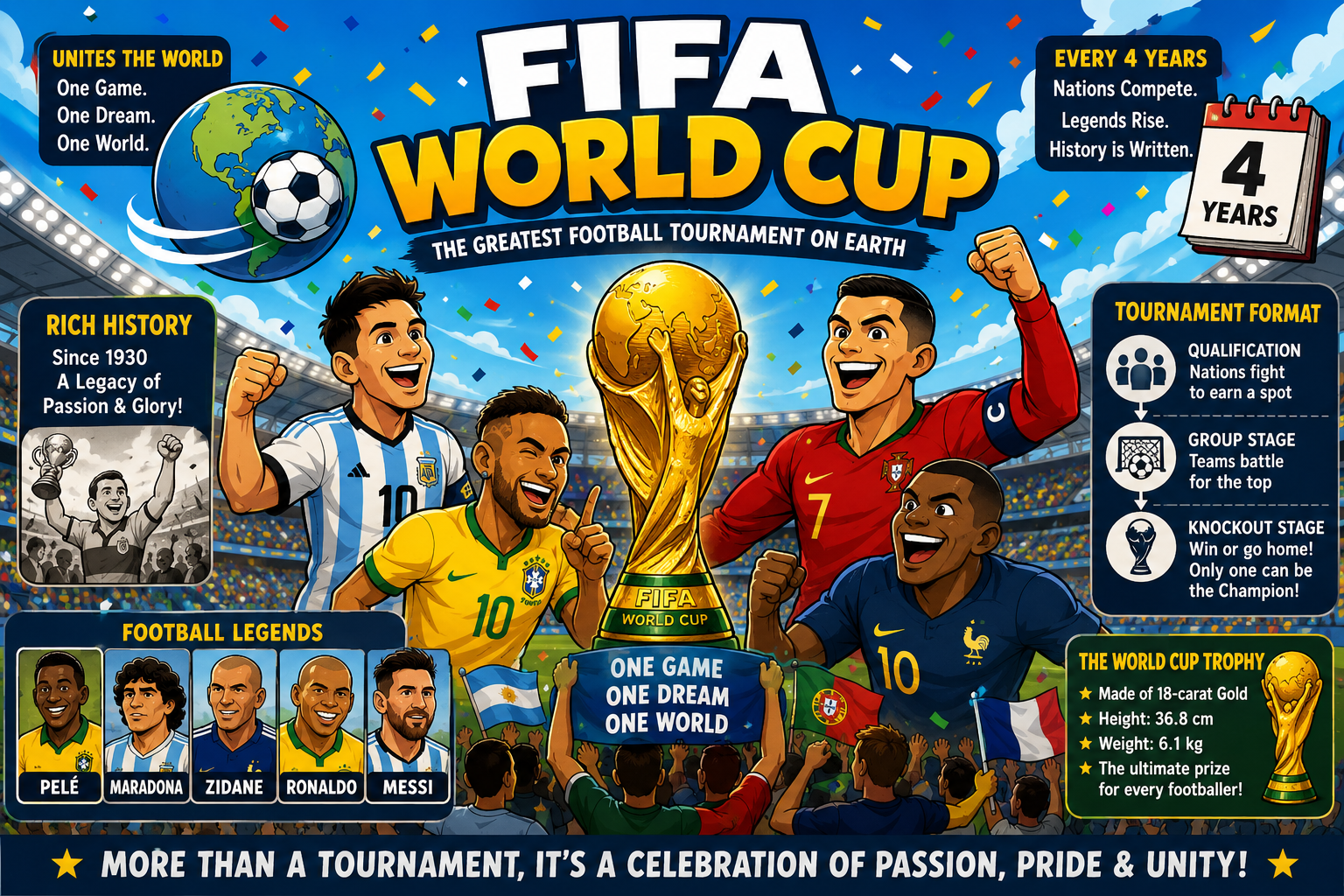
The FIFA World Cup is the most prestigious and widely watched football tournament in the world. Organized by the Fédération Internationale de Football Association (FIFA), the competition brings together the best national teams from across the globe to compete for the title of world champion. Held every four years, the tournament unites billions of fans, transcending borders, cultures, and languages through the universal love of football.
Since its inception in 1930, the FIFA World Cup has grown into one of the largest sporting events on the planet, showcasing unforgettable moments, legendary players, and historic achievements that continue to inspire generations.
History of the FIFA World Cup
The first FIFA World Cup was held in Uruguay in 1930, with just 13 participating teams. Uruguay emerged as the inaugural champions by defeating Argentina in the final.
The tournament was suspended during World War II, resulting in no World Cups in 1942 and 1946. It resumed in 1950in Brazil and has been held every four years since then.
Over the decades, the FIFA World Cup has evolved into a global celebration of football, attracting millions of spectators in stadiums and billions of viewers through television and digital platforms.
Tournament Format
The FIFA World Cup begins with a lengthy qualification process involving national teams from every FIFA member association. Only the strongest teams earn the right to compete in the final tournament.
Qualification Stage
- National teams compete within their continental confederations.
- Qualification lasts nearly three years.
- Only the top-performing teams secure a place in the World Cup.
Final Tournament
The qualified teams compete in two stages:
Group Stage
Teams are divided into groups and play a round-robin format.
- Win = 3 points
- Draw = 1 point
- Loss = 0 points
The top teams from each group advance to the knockout rounds.
Knockout Stage
The knockout rounds include:
- Round of 16 (or Round of 32 in the expanded format)
- Quarter-finals
- Semi-finals
- Third-place playoff
- Final
If a knockout match ends in a draw after 90 minutes, extra time and penalty shootouts determine the winner.
FIFA World Cup Trophy
The FIFA World Cup Trophy is one of the most recognizable sports trophies in the world.
Introduced in 1974, the current trophy stands approximately 36.8 centimeters tall and weighs around 6.1 kilograms. It is crafted from 18-carat solid gold with a base made of malachite.
Unlike the original Jules Rimet Trophy, the modern FIFA World Cup Trophy remains the property of FIFA. Winning teams receive a gold-plated replica for permanent display.
Legendary World Cup Champions
Several nations have etched their names into football history by winning the FIFA World Cup.
Brazil
Brazil is the most successful nation in World Cup history, winning five titles. The country is famous for producing football legends such as Pelé, Ronaldo Nazário, Ronaldinho, Kaká, and Neymar.
Germany
Germany has consistently performed at the highest level, winning four World Cups through disciplined and efficient football.
Italy
Italy has also won four World Cup titles, earning a reputation for tactical brilliance and exceptional defensive play.
Argentina
Argentina has produced some of football’s greatest icons, including Diego Maradona and Lionel Messi, capturing multiple World Cup championships.
France
France has established itself as a modern football powerhouse with multiple World Cup victories and a generation of world-class talent.
Legendary Players
The FIFA World Cup has introduced the world to some of football’s greatest legends.
Pelé
The only player to win three FIFA World Cups, Pelé became a global symbol of football excellence.
Diego Maradona
Maradona led Argentina to victory in 1986 with unforgettable performances, including the famous “Goal of the Century.”
Zinedine Zidane
The French legend inspired France to its first World Cup title in 1998 with extraordinary midfield brilliance.
Ronaldo Nazário
Known for his incredible finishing ability, Ronaldo helped Brazil secure the 2002 World Cup.
Lionel Messi
Messi fulfilled his lifelong dream by leading Argentina to World Cup glory, cementing his legacy as one of football’s greatest players.
Memorable World Cup Moments
The FIFA World Cup has delivered countless unforgettable memories.
Some of the most iconic include:
- Uruguay winning the inaugural World Cup in 1930.
- Brazil’s dominance during the Pelé era.
- Maradona’s legendary performances in 1986.
- France lifting the trophy on home soil in 1998.
- Spain winning its first World Cup in 2010.
- Argentina’s dramatic championship run led by Lionel Messi.
These historic moments continue to inspire football fans worldwide.
Economic and Cultural Impact
Hosting the FIFA World Cup provides countries with opportunities to improve infrastructure, boost tourism, and strengthen their international image.
The tournament generates billions of dollars in economic activity through:
- Tourism
- Broadcasting rights
- Sponsorships
- Merchandise sales
- Hospitality services
Beyond financial benefits, the World Cup promotes cultural exchange by bringing together fans from every corner of the globe.
Why the FIFA World Cup Is Special
Unlike club football, where players represent professional teams, the FIFA World Cup allows athletes to compete for their countries. Representing one’s nation creates unmatched passion, pride, and emotion.
Every four years, the tournament captures the attention of the world, creating unforgettable moments that become part of sporting history.
Looking Ahead
The FIFA World Cup continues to evolve with expanding participation, advanced technology, and increasing global popularity. New generations of football stars will carry the legacy forward while inspiring millions of young players around the world.
As football continues to grow, the FIFA World Cup remains the sport’s ultimate prize and the dream of every professional footballer.
Conclusion
The FIFA World Cup is more than just a football tournament—it is a global celebration of passion, teamwork, perseverance, and national pride. From historic victories to legendary players and unforgettable matches, the tournament has united billions of people through the beautiful game.
Whether you are a lifelong football supporter or a new fan, the FIFA World Cup represents the pinnacle of international sport, reminding the world that football has the power to inspire, connect, and create memories that last forever.