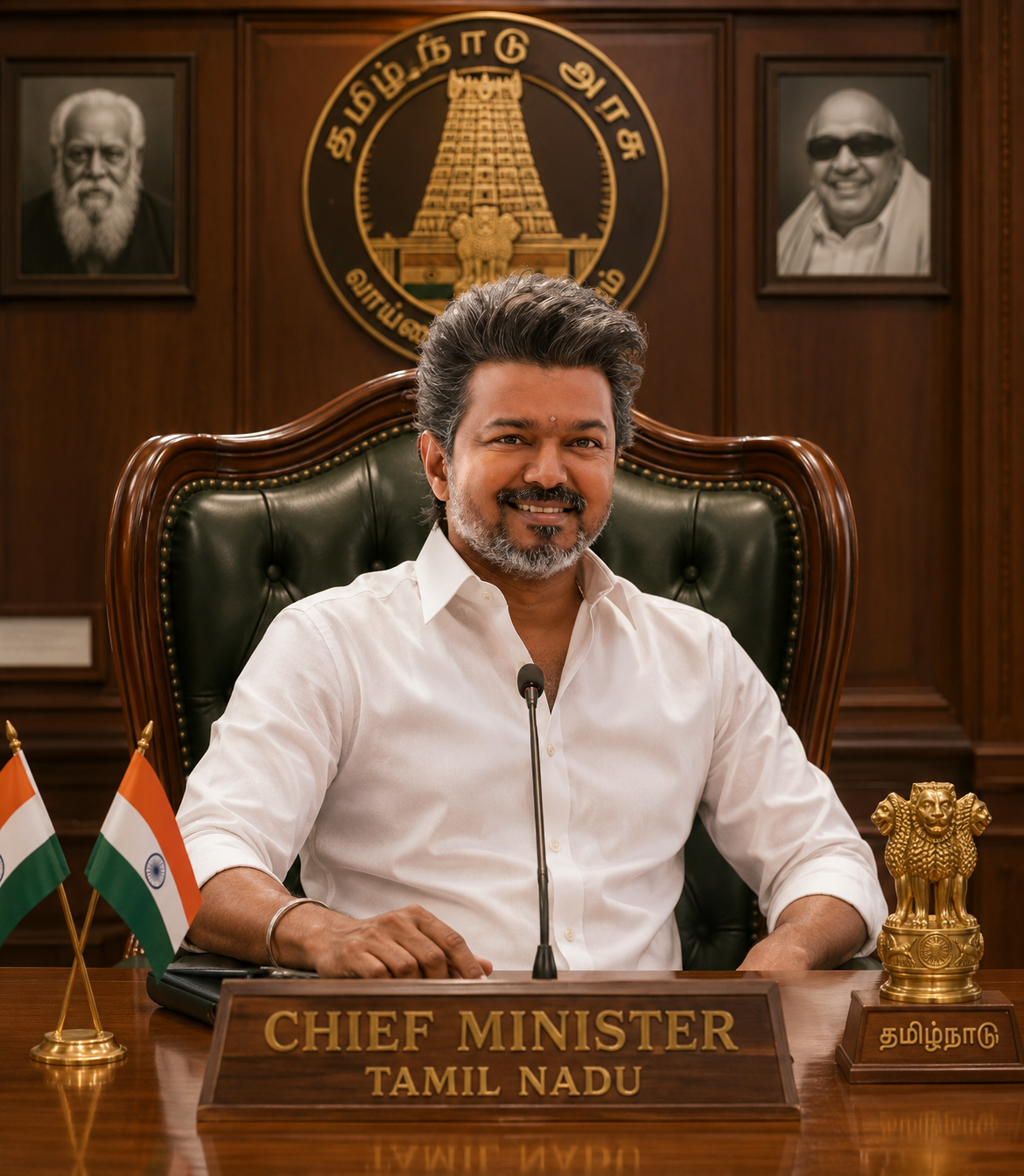
On Sunday morning, the actor who once ruled Tamil cinema took oath as the state’s ninth Chief Minister — shattering a political duopoly that had held unbroken for nearly six decades.
Special Report May 10, 2026 Chennai, Tamil Nadu
108 Seats won by TVK
120 Coalition MLAs
The clock had just struck 10 a.m. when Chandrasekaran Joseph Vijay — the man Tamil Nadu has always simply called Thalapathy — raised his hand before Governor Rajendra Vishwanath Arlekar at Chennai’s Jawaharlal Nehru Indoor Stadium and was administered the oath of office. In that moment, he became the ninth Chief Minister of Tamil Nadu, and the first in 59 years with no ties whatsoever to either of the Dravidian parties that had governed the state without pause since 1967.
Nine cabinet ministers were sworn in alongside him. Among the dignitaries watching from the front rows was Rahul Gandhi, Leader of the Opposition in the Lok Sabha — a presence that spoke to the national weight of what had just transpired. The Indian National Congress, long a subordinate partner in the DMK-led alliance, had crossed the aisle to back Vijay, and Gandhi’s attendance made clear that this was no ordinary regional event.
“Tamil Nadu did not simply vote for a candidate. It voted for the possibility that politics here could be something different.”
What TVK — Tamilaga Vettri Kazhagam — accomplished on April 23 defies easy comparison. Contesting alone across all 233 constituencies with no pre-poll alliance and no prior electoral history, the party returned 108 seats. The ruling DMK was reduced to 59; the AIADMK to 47. Turnout climbed to 85.1%, the highest the state had ever recorded. Vijay himself won from two constituencies: Perambur in North Chennai, with a margin exceeding 38,000 votes, and Tiruchirappalli East, by 27,216 votes.
Yet the path from election night to the Chief Minister’s chair wound through days of tense political manoeuvring. Falling 10 seats short of the 118 required for an outright majority, TVK found itself in coalition arithmetic. When Vijay met the Governor on May 6 to formally stake his claim, Arlekar demanded written proof of majority support — a request that temporarily froze proceedings and led to the withdrawal of the security convoy that had been assigned to Vijay as Chief Minister-designate.
How the coalition came together
April 23
Polls conclude; Tamil Nadu records an unprecedented 85.1% voter turnout across all 234 seats.
May 4
Results declared. TVK emerges as the single largest party with 108 seats — 10 short of a majority.
May 6
Vijay meets Governor Arlekar to stake his claim. The Governor seeks letters of majority support; Vijay’s security cover is withdrawn amid political uncertainty.
May 7
Congress breaks from the DMK-led Secular Progressive Alliance and pledges its five MLAs to Vijay’s coalition.
May 9
VCK and IUML announce unconditional support. CPI and CPI(M) follow, pushing TVK’s coalition total to 120 — two above the majority mark.
May 10
Vijay is sworn in as Tamil Nadu’s ninth Chief Minister at 10 a.m. at Jawaharlal Nehru Indoor Stadium.
The political tradition that Vijay now inherits is a storied one. M.G. Ramachandran, who built the AIADMK and swept to power in 1977, is the original template for the Tamil screen icon turned chief minister. J. Jayalalithaa, who starred in over 140 films before serving six terms as CM, is another. Vijay, who has named both as his political role models alongside Karunanidhi, is now the newest — and perhaps most dramatic — addition to that lineage.
Born in 1974 to director S.A. Chandrasekaran and playback singer Shoba Chandrasekhar, Vijay spent three decades building one of Tamil cinema’s most devoted fan followings. His journey from romantic hero in films like Kadhalukku Mariyadhai to action star in Ghilli and Thuppakki, and then to blockbusters like Master and Leo, made him a figure whose hold on popular imagination extended well beyond the multiplex. In February 2024, he announced his retirement from acting and launched TVK. Two years on, the experiment has produced the most seismic electoral debut in modern Tamil Nadu history.
Analysts point to several forces behind the wave: widespread discontent with the DMK’s five-year tenure, Vijay’s extraordinary success in converting his fan network into a disciplined political organisation, a digital campaign that positioned TVK as a clean break from the establishment, and — above all else — a hunger for change that cut across caste, class, and religion. TVK made its deepest inroads in urban centres: Salem, Coimbatore, Erode, Tiruchirappalli, Madurai. As Chief Minister, Vijay has committed to a floor test by May 13. The harder test — of governance — begins now.